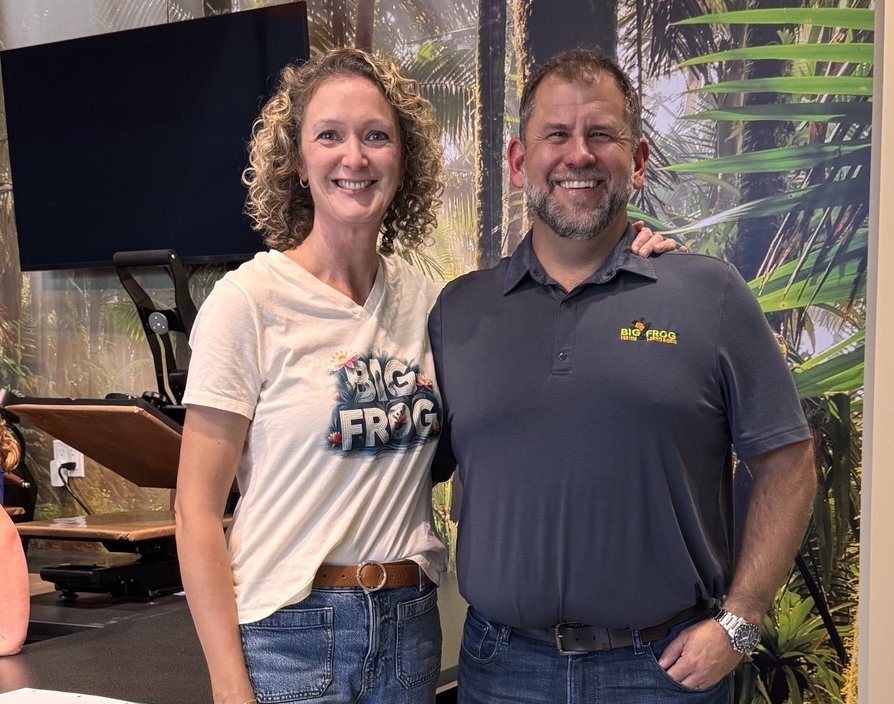
For many would-be franchise owners, the leap (no pun intended) into business ownership often starts as a conversation, but for Jason Evans and his partner Lisa, that conversation sharpened into something more tangible at a franchise event, as they searched for something rooted in timing, lifestyle, and the search for a business that felt right.
“We had always talked of running our own business, something we could do for ourselves as we approach the next stage of our life,” he says. “We came across Big Frog at a franchise show and were instantly drawn to the fun and creative aspect of it. We liked that it is a ‘feel good’ business and that it would connect us closer with our community.”
That sense of connection, both personal and local, is a recurring thread with the Evans. It is not just about selling custom apparel, it is about embedding a business into the rhythms of a community, something that often separates franchise success stories from those that struggle to find their footing.
Big Frog franchise onboarding and early support
The transition from idea to opening day is where many new franchisees either gain confidence or lose it. In this case, the reassurance of a solid business structure played a defining role.
“We had weekly calls with the franchise group and they helped with everything from guiding us through our location selection, lease agreement and all the necessary steps for the build out. The hands-on experience we gained through Big Frog University and Center of Excellence was extremely beneficial as it helped us to learn all about the business and answer all questions we had. The franchise group in the US and Canada have always been open and willing to help us with whatever we need.”
There was a clear emphasis here on process, with weekly calls, structured learning environments, and access to support across borders all part of a system designed to reduce uncertainty. For new owners, that kind of scaffolding can be the difference between hesitation and becoming a fully-functioning business.
That early grounding also shapes how operators approach the nuts and bolts of launching.
“Our past experiences helped us to maintain organization, systems and processes as we were going through our business launch. The past marketing experience benefited us with creating social media channels and connections within our community and creativity helped with the store displays and t-shirt samples.”
It is a reminder that while franchise systems provide the blueprint, the execution still leans heavily on the owners’ ability to bring their own skills into play. Operations, marketing, and creativity all intersect here, turning a standardized model into something that feels locally relevant.
Support continued to be hands on even at the point of opening.
“The Big Frog franchise team provided us with all the plans, documents and materials we needed for a successful set up. They spent a full week on-site at our store conducting hands-on training to ourselves and our staff.”
That physical presence, spending a week embedded in the business, reinforces the idea that onboarding is not just theoretical. It is tangible, practical, and immediate, giving new operators a chance to build confidence before the doors even open.
Ongoing support and coaching focus
If onboarding is about getting started, then ongoing support is about staying on track, and in franchise systems, that is often the real test of value.
“We never feel like we’re alone. Whether it’s marketing support, IT support, product knowledge support and overall business systems, there is always someone available and willing to help.”
Franchise ownership can be isolating without the right network, and the reassurance of accessible support becomes a quiet but powerful advantage. It’s why so many would-be franchise owners put such store in it when they are doing their initial due diligence.
Coaching, in particular, appears to provide an anchor for that ongoing relationship.
“Coaching was provided with a step-by-step pre opening plan covering all marketing initiatives with on-going marketing planning support after our opening date.”
A structured approach to coaching suggests a rhythm to the business, where planning does not stop once the launch is complete. Instead, it evolves into a continuous process, helping owners recalibrate as they move from startup mode into growth.
Franchise growth through local marketing
Growth, though, is rarely straightforward. Even with great support systems in place, new businesses face familiar challenges, particularly around visibility.
“One challenge was trying to reach a bigger audience outside of people just seeing our physical location. We worked through this by working with the franchise group to implement Google Ads and create a plan surrounding this. We have now run these for a couple of months and are generating more business through this avenue as people are now seeing us on-line.”
It is a familiar hurdle. A physical storefront can only take you so far, and expanding reach means investment in digital channels. What stands out is the collaborative approach, leaning on the franchise network to develop and execute a solution rather than navigating it alone.
At the same time, the business is building its identity through community engagement.
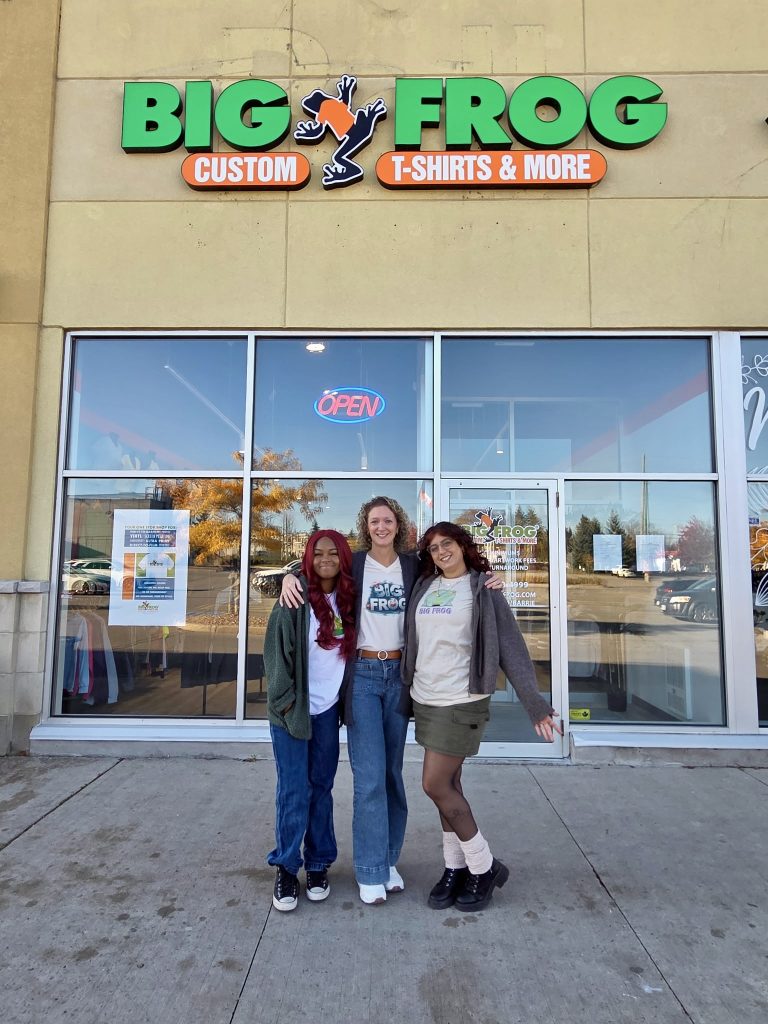
“So far we have worked on two fundraising initiatives (one with Big Brothers Big Sisters and the other with the Alzheimer Society) which is something that is important to us and connects us to our local community.”
That connection is not just a by-product of the business, or even just personal altruism, it is a deliberate strategy. Fundraising initiatives create visibility and also reinforce the “feel good” positioning that first attracted the owners to the brand. The hope is it will attract customers the same way.
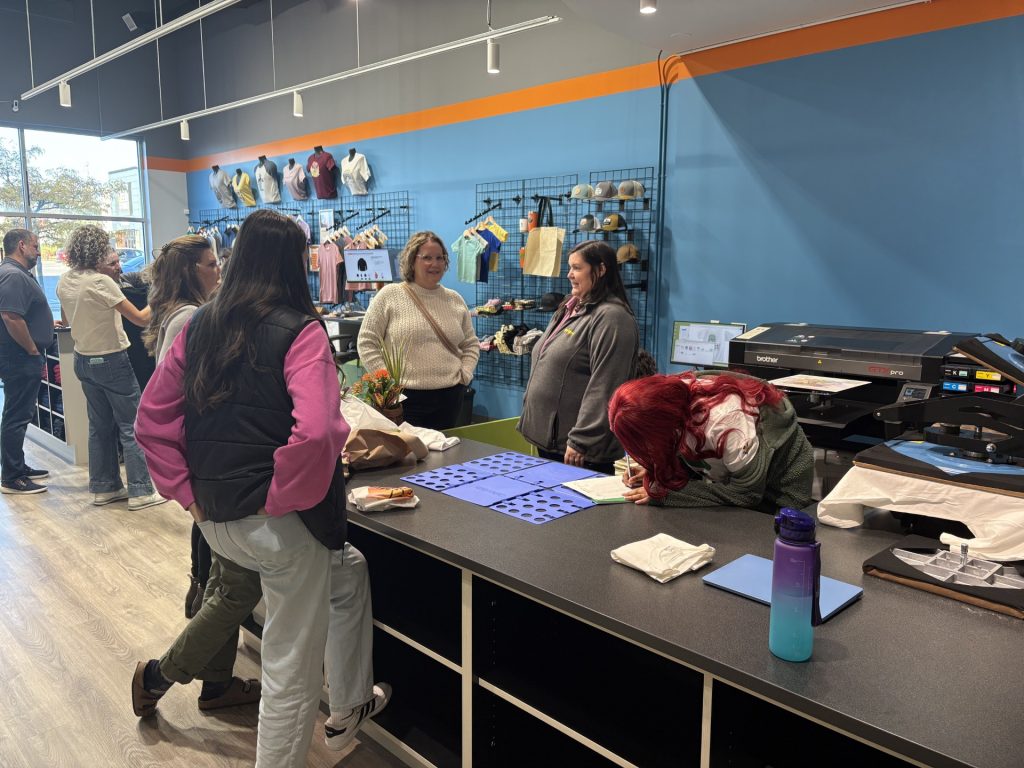
Building a community-driven franchise business
Beyond campaigns and initiatives, there is a more personal approach to building awareness.
“We talk to everyone we come across about our business and explain that we offer a full solution, not just one-off t-shirts. We have also aligned ourselves with some local gyms by initially offering them a ‘Free t-shirt with new membership’. This quickly developed into a partnership in which we are now providing them with solutions for their workout challenges, coach apparel and giveaways.”
It is a grassroots model of growth, including plenty of conversations, partnerships, and simple offers that evolve into longer-term relationships. The shift from one-off transactions to ongoing solutions suggests a business that is thinking beyond immediate sales and toward sustained engagement.
That same mindset is also carried into the pair’s future plans for the business.
“The plan is to grow our market share within our community and be the go-to spot for custom apparel. We see our partnership with Big Frog helping to leverage strategic supplier relationships and ultimately enhancing what we are able to offer our customers.”
It reflects a franchise approach where growth is incremental, supported by systems, partnerships, and a consistent presence in the local community.
The Evans’ franchise success has not been about rapid scale or overnight success, but an adherence to the existing structure, support, and connections offered by Big Frog.
A model with comprehensive onboarding, coaching to sustain momentum, and enough room for personal endeavor to provide the fuel for growth.