
The honest answer is that timing depends on dozens of moving parts: the clarity of your vision, decision-making speed, the complexity of your model, examiner comments in registration states, CPA and audit lead times, the results of trademark clearance, and the efficiency of your internal team and outside advisors.
We will cover the average timelines in this article.
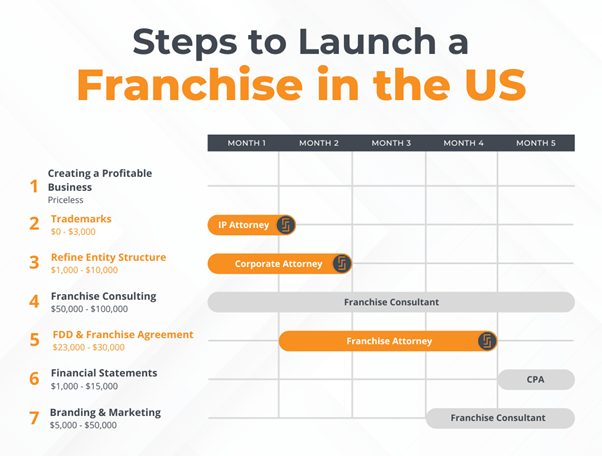
If you already run a profitable, well-operated business that others can replicate, you’ve done the hardest part. That foundation is priceless—and it can’t be rushed. With that in place, a thoughtful U.S. launch often comes together in roughly four to six months, assuming good momentum and few surprises. Think of the path below as a practical roadmap—not a promise—and expect us to recalibrate as facts emerge.
Month one: secure your trademark foundation
Begin with brand protection. Your franchise agreements hinge on the right to use your IP—ideally anchored by a federally registered trademark. Before you file, we strongly recommend a nationwide clearance search for your name and logo to surface conflicts early; it’s far easier (and cheaper) to resolve naming issues before you launch than after.
Have an experienced IP attorney review your marks for enforceability and national validity. Trademarks are the keystone of a franchise system; this step sets the tone for everything that follows. (And yes, U.S. trademark registrations can be completed after the launch —that’s common. We build a smart interim strategy while the application progresses.)
Month two: form the franchisor entity and assemble the A-team
This is the moment to establish a new franchisor entity and, where there are multiple owners, adopt a crisp operating or shareholders’ agreement. Governance clarity now prevents expensive ambiguity later.
In parallel, bring on your franchise consultant (whose work typically runs through month five) and engage a franchise attorney who represents you directly—not through a third party. Preserving attorney-client privilege and getting business-savvy counsel is critical.
Months two–five: consultant deliverables
Your consultant drives the engine room while legal documents take shape. Expect delivery of:
- an operations manual (table of contents is needed for the FDD),
- a strategic plan covering competitive positioning, royalties, fees, territory definition, initial investment, and unit economics,
- training architecture,
- pro formas and an early-stage budget for the system.
These pieces inform the legal, financial, and marketing tracks—and accelerate decisions later.
Months two–four: draft the FDD and franchise agreement
While you are working on the details of your business model, a franchise attorney drafts the Franchise Disclosure Document and Franchise Agreement—the heart of your offer. A well-crafted FDD supports growth; a careless one slows it down and increases risk. You’ll update these documents annually and, if you wish to sell in registration states, you’ll navigate state filings and examiner comments. Expect variability here; some states are quick, others take longer to grant approval.
Month five: financials and go-to-market
You’ll need separate financial statements for the franchisor entity. Depending on your initial target states, a CPA audit may be required for launch. In the same window, your consultant finalizes brand messaging and marketing assets—site, collateral, and campaign plan—so the market hears a clear, compelling value proposition for both customers and prospective franchisees.
Understanding state registration
Roughly fifteen states (depending on the status of your trademarks registration) require annual registration and approval before you can start offering franchises. Review cycles can span a few weeks to a few months and often involve comment letters, revisions and resubmissions. As you grow, managing a multi-state compliance calendar becomes complex; modern tracking systems make it far more manageable and help you know where you can sell, and when.
Annual renewals and updates
Once you’re approved to offer franchises, plan on updating your FDD annually and renewing state registrations on their schedules. Expect a busy season tied to your fiscal year-end: 120 days to renew your registrations and finalize the update of your FDD.
Timing
Every brand is unique, but the steps are consistent. With strong preparation, decisive leadership, and an experienced team, moving from “go” to first deal can land in the four-to-six-month range. That said, we treat the timeline as a living forecast, not a guarantee—shaped by efficiencies gained, bottlenecks removed, and the nuances that arise in real life.
Your team
Your trademark counsel, corporate counsel, franchise consultant, franchise attorney, and CPA each play a distinct role. Our job is to orchestrate these workstreams, maintain momentum, and keep you compliant while you build a system worthy of your brand. When we work in tight cadence—communicating early, deciding quickly, and adapting as facts change—the path forward is clear and achievable.