
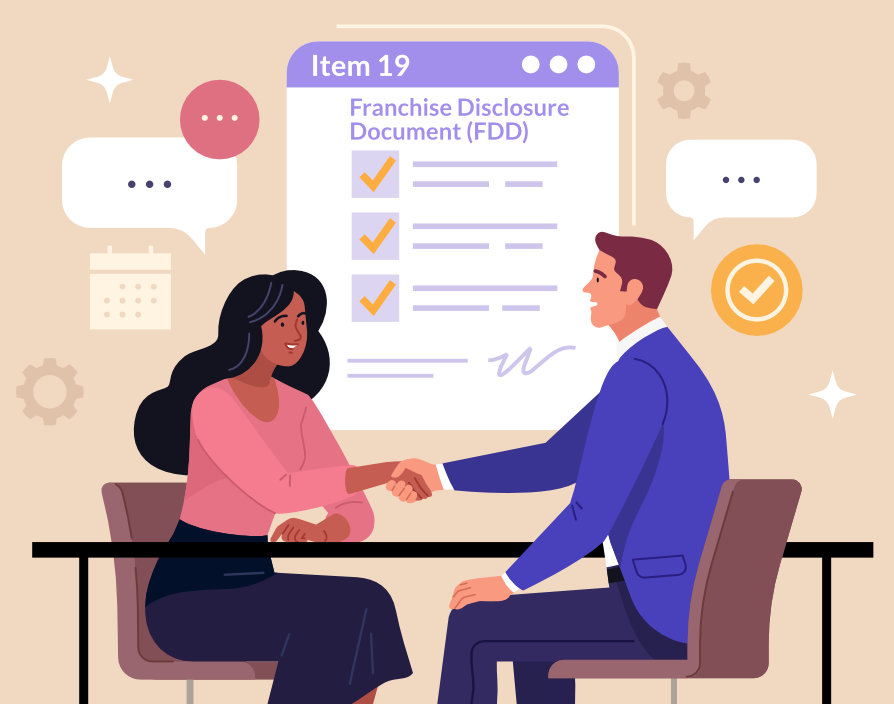
What catches many brands off guard is not the paperwork. It is the sales conversation.
In the U.S., franchising is heavily influenced by disclosure rules and the expectation that prospective franchisees receive consistent, supportable information before they sign. The area that creates the most avoidable exposure is the discussion of financial performance, what most people casually call “how much money a franchisee can make.”
What Item 19 actually is
In a U.S. Franchise Disclosure Document (FDD), Item 19 is the section where a franchisor may choose to provide financial performance representations (FPRs), meaning sales figures, gross revenue, margins, costs, net profit, or similar economic metrics. Item 19 is optional, but the moment a franchisor, or anyone selling on its behalf, provides financial performance information to a prospect, the conversation can create legal obligations and should be reflected in Item 19.
This is the important point: a franchisor can trigger Item 19 issues without ever intending to. It can happen in a slide deck, an email follow-up, a discovery call, a webinar, a broker pitch, or a franchisee-to-prospect conversation that the franchisor encouraged.
What counts as an earnings claim in practice
In the real world, “earnings claim” is broader than many founders assume. It is not limited to “you will earn $X.” It often includes:
- “Most franchisees do $___ in annual sales.”
- “Our average unit hits break-even in ___ months.”
- “You can expect % margins.”
- “Owners typically take home $.”
- “Here’s what a location in your market will likely produce.”
- “These are the numbers for our top performers.”
Even if the statement is framed as informal, aspirational, or based on “typical” results, it can still be treated as a financial performance representation.
One more nuance: a disclaimer does not fix an unsupported claim. If a number is presented, the better approach is to make sure it is properly substantiated, consistently communicated, and disclosed in a compliant way.
Why this becomes a bigger issue when you expand into the U.S.
U.S. franchise sales frequently involve multiple touchpoints: founders, franchise development staff, third-party brokers, lead-generation partners, and automated content such as ads, landing pages, and nurture sequences. Each touchpoint is a chance for someone to introduce a number, a “typical result,” or a payback promise that was never vetted.
If you are entering registration states, these issues can become more acute. Regulators review FDDs closely, and inconsistencies between the document and sales messaging can lead to consequences.
A practical way to talk economics without creating problems
Most serious prospects will ask about financial performance. You do not need to dodge the question. You need a system. Here are four approaches that can help you stay informative while reducing risk.
Decide your strategy: Item 19 present or Item 19 silent
Some brands choose to include an Item 19 because they can substantiate a clean data set and want to control the narrative. Others choose not to include one, particularly early on, and keep conversations focused on the business model and operational requirements. Either choice can work. The danger is drifting into a “silent Item 19” while the sales team informally shares numbers anyway.
If you share numbers, share them in a disciplined way
If your system will provide financial performance information, it should be:
- Clearly defined, including what is being measured, the time period, and included and excluded categories
- Supported by records you can produce if challenged
- Presented consistently, with no improvising ranges or “typical” results on calls
- Matched to the exact wording and tables in the FDD
Consistency matters. If prospects hear one story on a call and read another story in disclosure, you have created both a credibility problem and a compliance problem.
Control the sales ecosystem: Brokers, employees, and partners
Many franchisors can manage what employees say, but forget the extended sales ecosystem. A practical compliance plan includes:
- Approved pitch decks and FAQs, with version control
- Required training for anyone who speaks to prospects
- Written broker instructions
- A clear rule that franchisees should not provide performance claims to prospects as part of the sales process
- A process for reporting and correcting off-script statements quickly
If you do not control the message, the market will control it for you.
Use process transparency when you do not provide an Item 19
If you choose not to include an Item 19, you can still answer the underlying question responsibly by focusing on:
- What drives results in the model, such as labor, pricing, throughput, local marketing, and cost controls
- The operator profile that tends to succeed
- The expected ramp-up work and operational milestones
- Encaging prospects to conduct thorough validation with existing franchisees, without directing or scripting franchisees to share numbers
This keeps the conversation educational and avoids drifting into promised outcomes.
The goal: Reduce risk while improving trust
Prospects are not just looking for big numbers. They want clarity, realism, and consistency. A well-designed approach to Item 19 and financial discussions protects the brand, speeds up the sales process, and reduces the likelihood of disputes later.
If you are planning a U.S. launch, this is worth addressing early. Spadea Lignana Franchise Attorneys regularly works with franchisors on U.S. disclosure strategy and sales compliance systems so financial performance discussions stay consistent, supportable, and aligned with U.S. franchise compliance requirements.