One thing is clear: the next generation of franchise locations will not simply display information they will also welcome customers through an AI concierge, beam a spokesperson into an event live, turn walls into interactive digital environments, use robots to greet, guide, sell and support staff, capture leads and create new sponsor opportunities. The challenge is turning one compelling experience into a repeatable system across multiple locations.
Freeman’s 2025 research found that when event attendees did not receive a hands-on experience, 42 percent were more likely to shift their attention to another vendor.
Among people who did interact with a product or experience, 96 percent said it helped them advocate for a purchase. This statistic illustrates that customers not only want to see the brand; they also want to experience it. A giant screen playing the same corporate video for eight hours does not cut the mustard because it is not immersive; it is nothing more than a very expensive screensaver.
Location is becoming part of the marketing. Franchise locations used to be the final destination. An ad brought someone to the store, a sign told them they had arrived and an employee took over from there. Today the location itself can become a showroom, a stage, a lead-generation platform, a sponsor-supported media property, a customer-service centre or a social-content studio. A robot can attract someone from across the room, answer basic questions and collect their information. For example, a holographic display can feature a live spokesperson in the morning, operate as an AI concierge in the afternoon and present sponsor content during an evening event. Meanwhile a video wall can explain the offer, react to the visitor and change based on what happens next. The technology is no longer waiting quietly in the corner; it is joining the sales team.
Technology
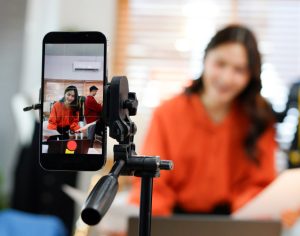
Holographic displays, including systems such as HoloBox, can show a remote person live, play prerecorded content or host an AI-powered digital character. For franchises this opens several possibilities. A live spokesperson such as a founder, celebrity ambassador, trainer, chef or product expert can appear live at conferences, grand openings, franchise sales events, trade shows, regional meetings or sponsor activations. In the meantime the audience can ask questions and receive answers in real time, turning a simple video into a conversation.
When the live person signs off, the same display can become an AI concierge that answers questions such as where the next session is, which territories are available, what the sponsorship package includes, whether the information can be sent to a phone, or which product is best for the visitor. The concierge can work from an approved knowledge base, speak multiple languages and connect the visitor to a booking form, kiosk, CRM or employee. What was once science fiction has now become a business workflow.
Video walls used to belong mainly to television studios and high-budget events; that has changed because large-format LED walls, commercial displays and rental systems have become more accessible and easier to deploy. For a franchise a video wall can become a cinematic brand introduction, a live social-media wall, an interactive product catalogue, a sponsor-recognition platform, a digital menu, a real-time event schedule or a backdrop for interviews and customer content. Yet size alone does not create immersion; a twenty-foot PowerPoint is still a PowerPoint. The strongest experiences combine motion, audio, lighting, touch or sensors, live data, audience participation and a clear next action. The screen grabs attention, the interaction creates interest and the call to action creates value.
Audio is not an afterthought. Many immersive projects spend heavily on screens and treat audio like something somebody will remember ten minutes before launch. That is backwards. Audio tells people where to look, what changed, when to react, what emotion the experience should create and where to go next. A holographic spokesperson with bad audio becomes a very realistic mime. A robot without the right voice becomes an expensive luggage cart. Good immersive design starts with the entire experience, not just the screen size.
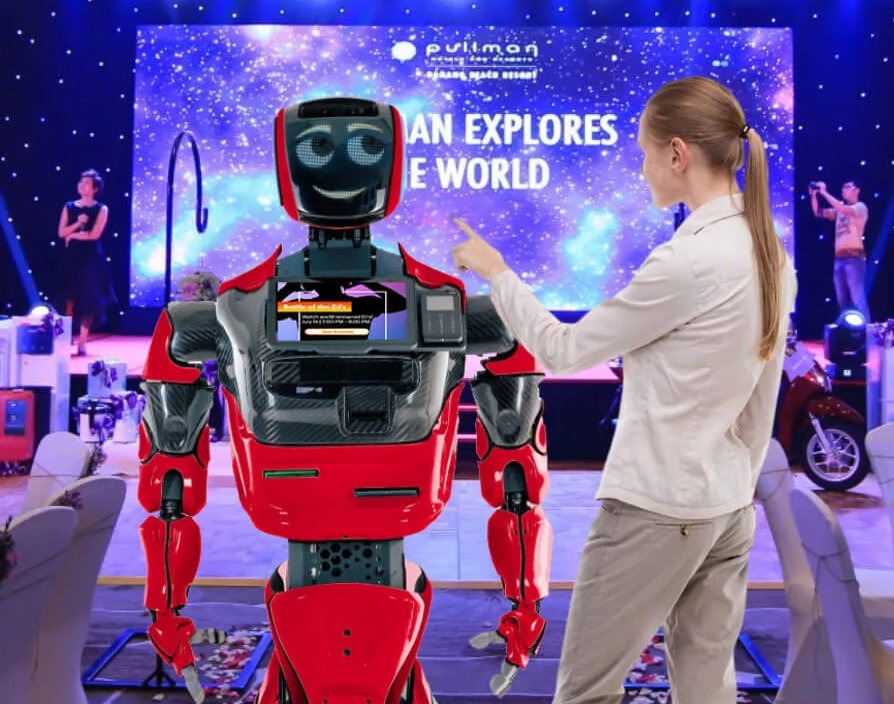
Robots are moving from novelty to workforce. While robots still attract cameras, children and adults pretending the photo is only for their children, they can also perform real work. Depending on the environment they can greet visitors, provide directions, promote products and sponsors, guide guests to seats or tables, deliver food, drinks or supplies, carry digital advertising, collect feedback and support cleaning and hospitality tasks. The goal is not to remove hospitality but to remove repetitive work that prevents employees from providing hospitality; hence the robot carries the plates while the employee notices that it is someone’s anniversary. This creates a better division of labour.
Sales and marketing
Immersive technology can create new event revenue because sponsors want more than another logo on a lanyard; they want attention and proof that people are engaged. Sponsors increasingly want experiences that generate measurable engagement rather than static branding. Immersive technology can support that through interactive activations and content that evolves throughout an event. This provides a much stronger return on the same physical footprint.
AI is making content production faster and more affordable. Brands can create prototypes, localise campaigns and test ideas before investing in large productions. The opportunity is not to replace professional production but to validate concepts before committing bigger budgets.
Successful immersive experiences follow a simple path: capture attention, encourage interaction, personalise the experience, convert interest into action and measure the results. Whether the goal is a booking, sale or lead, the technology should support a clear commercial objective rather than exist for its own sake.
Common mistakes include buying technology without a business objective, showing content without allowing interaction, creating interaction without capturing a lead or sale, using too many technologies at once, forgetting the audio and having no plan to update the content. If the hologram is speaking, the robot is singing and the video wall is flashing three different offers, the result is a casino inside an airport. The underlying message is to create one clear journey.
Homepage
People do not leave home to experience another website mounted on a wall; they leave home to feel something they could not get from a browser. The winning franchise locations will combine the emotion of a physical environment, the intelligence of AI, the reach of digital content, the consistency of a franchise system and the measurable action of a sales platform. A holographic spokesperson can be in several cities. A video wall can turn one room into several worlds. A robot can attract attention and handle repetitive work. An AI concierge can provide approved answers without taking a lunch break. The future of franchising will not only be automated; it will also be interactive, physical and impossible to ignore. Therefore stop asking which screen should be purchased and start asking what the customer should feel, do and buy. That is where the experience begins. What the customer should feel, do and buy. That is where the experience begins.